The short answer
Turn taking practice tends to go best in short games where an adult plays too. Keep each turn very brief, say whose turn it is, and hand the turn back quickly so the wait never feels long. Use shared things, such as one ball or one tower you build together, rather than asking a child to hand over a toy of their own. A child can take a turn by pointing or passing an object instead of speaking. Stop or switch games when your child is upset or has had enough.
About these ideas. These are general ideas for play at home. They are not our lesson plans or a description of how our classes run, not therapy, and not a test. There is no score, no pass mark and no age by which a child should manage them.
Taking turns is not the same as giving things away
Taking turns means sharing an activity that belongs to everyone in the game: rolling one ball back and forth, or adding blocks to one tower. Giving away a personal possession is something different. A child who is asked to hand over a favourite toy, a comfort item or something they brought from home may feel they are losing it, not taking a turn.
For these games, choose shared materials and let your child keep a special toy for themselves. Before a friend or cousin visits, you could ask your child which one or two things they would like to put away, and bring out things that everyone can use.
How an adult can help
- Play too, and go first. A short, cheerful "my turn", followed quickly by "your turn", shows how the game works better than an explanation.
- Keep turns very short at first. One roll, one block or one tap each. Longer turns can come later, if your child is enjoying it.
- Say whose turn it is, every time. Point to yourself and then to your child, or hold up the cue cards below, so the turn can be seen as well as heard.
- Words are optional. Your child can take a turn by pointing, nodding, passing the object or touching a card. Offering a choice of two, such as "the red block or the blue one?", lets a child join in without needing many words.
- Notice what went well. A short, specific comment such as "you waited, and then it was your turn" describes what happened without turning it into a test.
- Stop while it is still fun. If your child becomes upset, wanders off or loses interest, pause, change the game or try another day.
Why games are a good place to practise
The Center on the Developing Child at Harvard University publishes free activity guides for families and caregivers. They describe everyday games, songs and play as ways for young children to practise skills such as focusing, remembering simple rules and holding back an impulse, with adults adjusting the activity to suit the child. We use those guides as general background only. The examples below are general home-play ideas, not a prescribed curriculum or a description of our programme.
Five short games to try at home
Each game needs one adult and one child, takes a few minutes and uses large, safe things from around the home. Stay with your child the whole time.
Roll it back
Set up. Sit on the floor facing each other, a short distance apart, with a soft ball too big to fit in a mouth.
Whose turn. Say "my turn" as you roll the ball, then "your turn" as it reaches your child. Your child rolls it back.
Change it. Sit closer if the ball keeps rolling away. Add a brother or sister and roll to the person you name. If your child would rather hold the ball for now, let them and try again later.
One block each
Set up. A few large blocks, plastic cups or sturdy boxes, and one tower you build together.
Whose turn. Take turns adding one piece. Say whose turn it is before each piece goes on.
Change it. If the tower falls, that is part of the game; start again together. Let your child choose which piece you add on your turn, so they still have a job while they wait.
Copy my taps
Set up. An upturned plastic tub to tap with your hands, or a cushion for a quieter sound.
Whose turn. Tap a short pattern, such as two slow taps, then say "your turn". Your child taps back. Then swap, so your child leads and you copy.
Change it. Clap instead if tapping is too loud. Your child's taps do not need to match yours; any taps count as a turn.
Page by page
Set up. A sturdy picture book your child already likes.
Whose turn. Take turns turning a page, or take turns pointing to one thing on each page for the other person to find too.
Change it. Let your child choose the book. If your child wants to turn every page, you can take the pointing turns instead.
Add to the drawing
Set up. One large sheet of paper and two chunky crayons.
Whose turn. Take turns adding one thing to a shared picture: a circle, then eyes, then a smile, or a house, then a door.
Change it. On your turn, your child can tell you what to draw or point to where it should go. There is no right result.
When waiting is hard
Waiting for a turn asks a lot of a young child, especially when the thing they want is right in front of them. Grabbing, protesting or walking away are common, and they do not mean the game has failed.
- Shorten the wait. Hand the turn back quickly, or give your child something to hold while they wait, such as the "my turn" card.
- Name it simply. "It is hard to wait. Your turn is next."
- Do not force it. Avoid taking a personal toy away to teach a lesson. Go back to shared materials, or end the game calmly and try another time.
- Start with two players. More players mean longer waits. Add another person once the game feels easy.
Every child plays differently
Some children enjoy these games straight away. Others watch first, prefer to play on their own for now, or join in for only a turn or two. These ideas are practice, not an assessment. If you have questions about how your child plays with others, ask their teacher what they see in class.
What to ask on a school visit
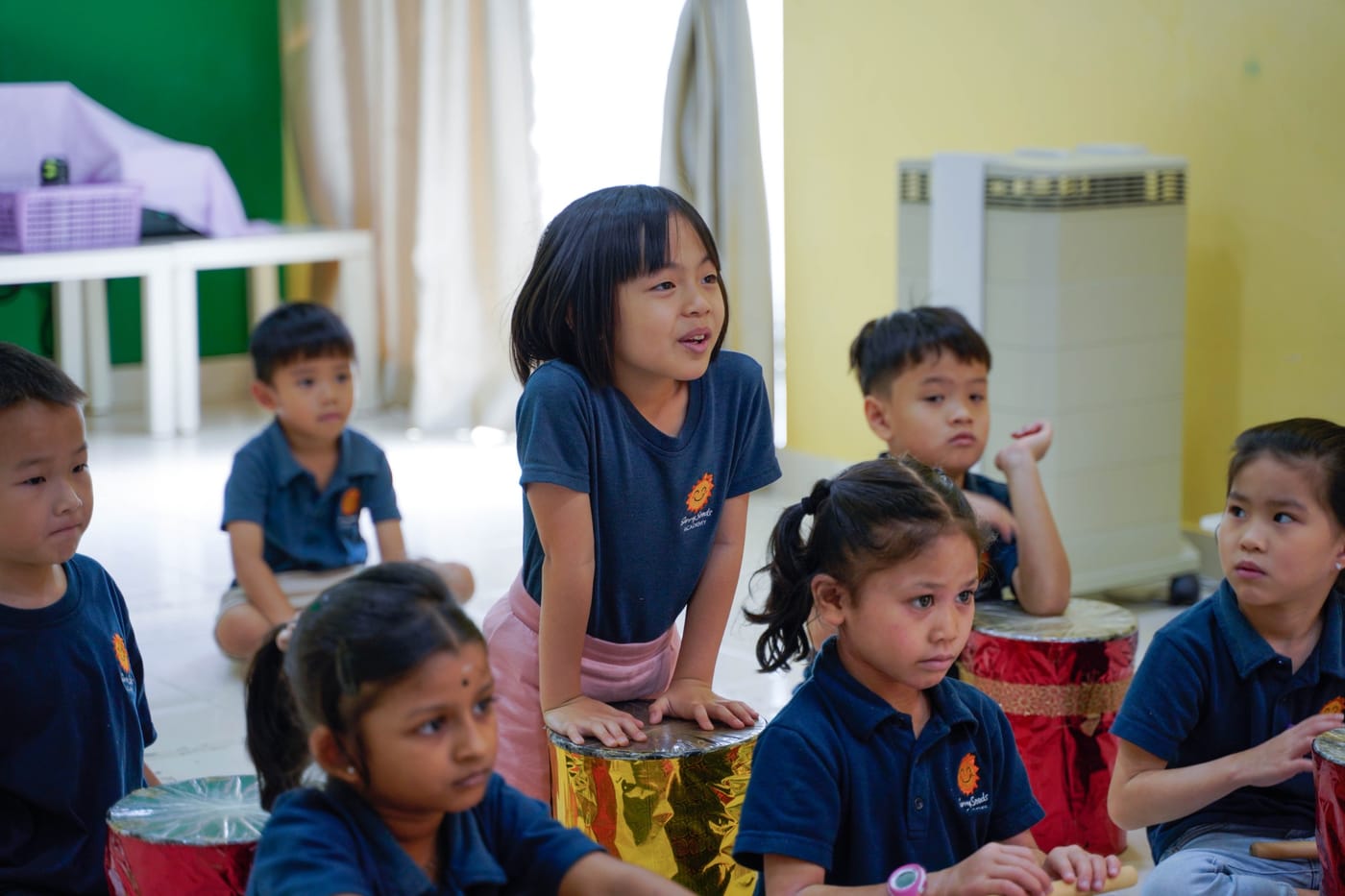
Children also take turns through a preschool day, in group activities, at snack time and with shared equipment. On a visit you could ask how children take turns with things everyone uses, what the adults do when two children want the same thing, how a quieter child or a child who uses few words joins group time, and how you will hear about your child's friendships and play. Our learning approach lists social and emotional learning, including empathy, conflict resolution and self regulation, as one of the six Teaching Lenses our teachers use to plan, and our school tour checklist has more questions for any visit.
At SunnySeeds
Our learning approach describes lessons that balance structured learning, meaningful play, interest based learning and outdoor exploration, and collaboration is one of the five habits in our Growth Loop. In Nursery, for ages 2 to 3, the focus is play based and sensory learning, and children continue in Preschool, age 4, and Kindergarten, ages 5 and 6. For more home ideas, our show and tell guide has prompt cards for talking to a small audience, and our guide to play based or academic preschool explains how play and structured learning fit together.