
Free play
Children choose what to do and how: blocks, pretend play, drawing, outdoor play. Adults keep it safe, watch, and join in when invited. Children try out ideas, negotiate with friends and keep going at something they care about.
Parent guide
Parents are often asked to pick a side. In practice the real question is the mix: when children play freely, when an adult guides the play, and when they practise something directly.
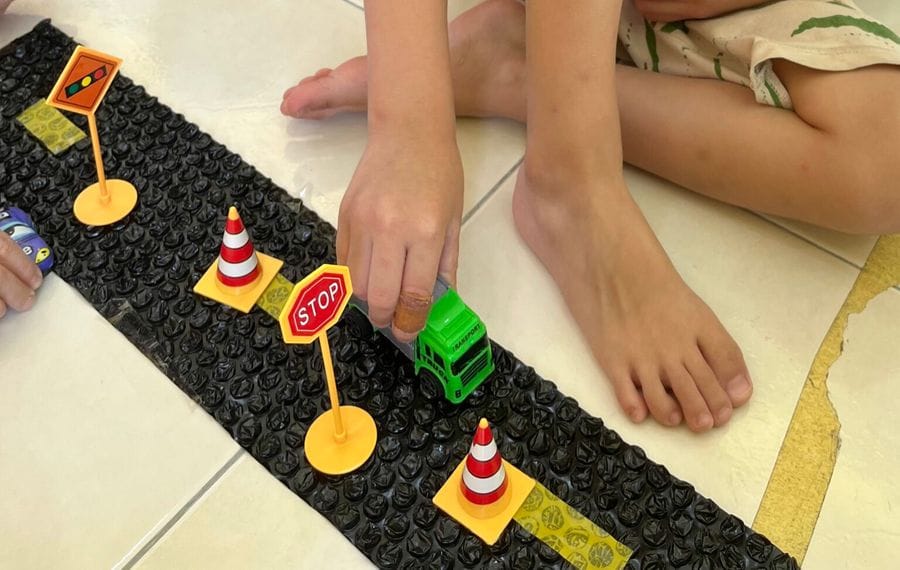
It is rarely a choice between the two. Young children learn a great deal through play, and they can also gain from short, guided practice, such as hearing letter sounds or counting objects with an adult. Preschools differ in the balance, and in how well the adults connect the two. Rather than asking whether a centre is play based or academic, ask what a child's morning is made of.
Children choose what to do and how: blocks, pretend play, drawing, outdoor play. Adults keep it safe, watch, and join in when invited. Children try out ideas, negotiate with friends and keep going at something they care about.
An adult sets something up with a purpose and follows the child's lead inside it: a pretend shop where children pay with counters, a sorting game, or a puppet story where the teacher asks what happens next.
Short, direct teaching of something specific, such as a letter sound, a BM syllable, a Mandarin stroke or counting to ten, then a chance to try it. It tends to work well when it is brief, active and linked to something children have played with.
Arrival, tidy up time, washing hands, meals and goodbyes are learning too: following steps, taking turns and looking after belongings.
A centre that calls itself academic may still use games and hands on materials. A centre that calls itself play based may still teach letters and numbers. Each label describes an emphasis, not a whole day.
UNICEF's parenting resources describe play, both free play and everyday activities with adults, as a learning opportunity. Its Care for Child Development materials describe responsive play and communication as chances for children to practise thinking, language, movement and getting along with others. None of that rules out short, focused teaching; it puts it in context.
The risk at either end is the same: a day that does not fit the child. Long stretches of sitting and copying can be hard for a three year old. A day with little adult guidance can leave some children stuck. How the adults move between play and practice tells you more than the label.
Our printable school tour checklist has more questions for any visit, with space for the answers.
No single balance suits every child. A child who is new to group settings may need more time to play and settle; a child who loves numbers may enjoy more guided challenge. Tell the teachers what your child enjoys and finds hard, and ask how the day would adapt. For ideas at home, our guide to fine motor play has six supervised activities with everyday materials.
Our learning approach describes lessons that balance structured learning, meaningful play, interest based learning and outdoor exploration, with teachers who observe, guide and extend learning to each child's readiness. In Nursery, for ages 2 to 3, the focus is play based and sensory learning, with free play, blocks and puppet adventure. In Preschool, for age 4, it moves to discovery learning and early academics, with Eureka Maths, science and reading in three languages alongside free play. Come during a morning and see the mix for yourself.
Sources checked 4 November 2026. Official pages can change, so check the source before acting on a date or rule.
FAQ
Neither label settles it. Young children learn through play and can also gain from short, guided practice. Ask a centre what a morning is made of and how its adults connect play with focused activities.
Many play based centres teach early literacy and numeracy through short guided activities, songs, stories and games. Ask how reading starts in each language the centre teaches, and how progress is shared with you.
Come during morning school hours to see what we do, and bring your child along.