
Parent guide
Preschool counting activities: understanding numbers beyond reciting them
Many children can say the numbers to ten, or even twenty, before they can count a group of things and tell you how many there are. Reciting and counting are related, but they are not the same. This guide explains the difference and gives simple, supervised games to try at home.
The short answer
Saying "one, two, three" in order is a good start, but counting a group asks for more. Your child touches or points to each object once and says one number for each, understands that the last number said tells how many there are, links a written numeral such as 5 to an amount of five, and learns that the amount stays the same when the group is moved around. These ideas grow slowly through everyday talk and play, and children get there at different times.
About these ideas. The games and the matching cards in this guide were written by SunnySeeds Academy for families to try at home. They are not our lesson plans, not part of a prescribed curriculum, and not a test. There is no score and no pass mark.
Reciting numbers and counting are different
Reciting is saying the number names in order, a little like a song. Counting a group asks a child to do several things at once: say the names in order, match one name to each object, keep track of which objects have been counted, and stop at the end. A child who says "one, two, three, four, five" quickly while pointing at three blocks is reciting, not yet counting the blocks. That shows which part you can practise together.
Four ideas behind counting
The NSW Department of Education in Australia describes the ideas below in its early childhood numeracy guidance for educators. We use them as general background only. They are not the Malaysian preschool curriculum and not a description of our own programme.
- One number for each object. Each object is counted once and only once, often by touching it or moving it aside.
- The last number tells how many. After counting four cups, the answer to "how many cups?" is four, without counting again.
- Numerals stand for amounts. The written 4, the spoken word "four" and a group of four things all mean the same amount.
- Moving things does not change how many. Counting the same group again, spread out, bunched up or in a different order, gives the same number.
Supervised games to try at home
Keep each game to a few minutes and stop while it is still fun. Use large, everyday things that cannot fit in a mouth, or drawings on paper, and stay with your child the whole time.
- Setting the table. Your child gives one plate to each person at the table, then you count the plates together. "How many plates? How many people?" Plastic plates or cups work well.
- Big block towers. Build a tower from large blocks and count them as you go. When you finish, ask "how many?" and wait before counting again.
- Count the drawing. Draw a few large circles, stars or smiling faces on a sheet of paper. Your child touches each one as you count together, then you ask how many there are.
- Spread it out. Count three large blocks in a row, then spread them apart and ask "how many now?" Some children count again and some know straight away. Both are fine; talk about what happened.
- Match the card. Use the cards below. Put a numeral card next to the amount card with the same number of dots, and say the number together.
- One more, one less. With a few large blocks or drawn dots, add one and ask how many there are now, or take one away. Count again together to check. There is no right speed.
Numbers in everyday life
Numbers are all around a young child: the buttons in a lift, the steps up to the door, the fruit in a bowl. A short question in passing, such as "how many steps did we climb?", gives practice without turning it into a lesson. You can count in English, Bahasa Melayu, Mandarin or the language you speak at home. The ideas behind counting are the same in any language.
What to avoid
- Small loose items such as beads, buttons, coins, dried beans or pebbles, which a young child could choke on. Use large objects or drawings instead.
- Turning practice into a test, timing your child or comparing them with other children.
- Worrying when your child skips a number or counts something twice. Count again together, slowly, and move on.
Every child counts at their own pace
These home games are practice ideas, rather than an age assessment. Start with a group your child can explore comfortably. If you have questions about your child's progress, ask their teacher what they see in class.
At SunnySeeds
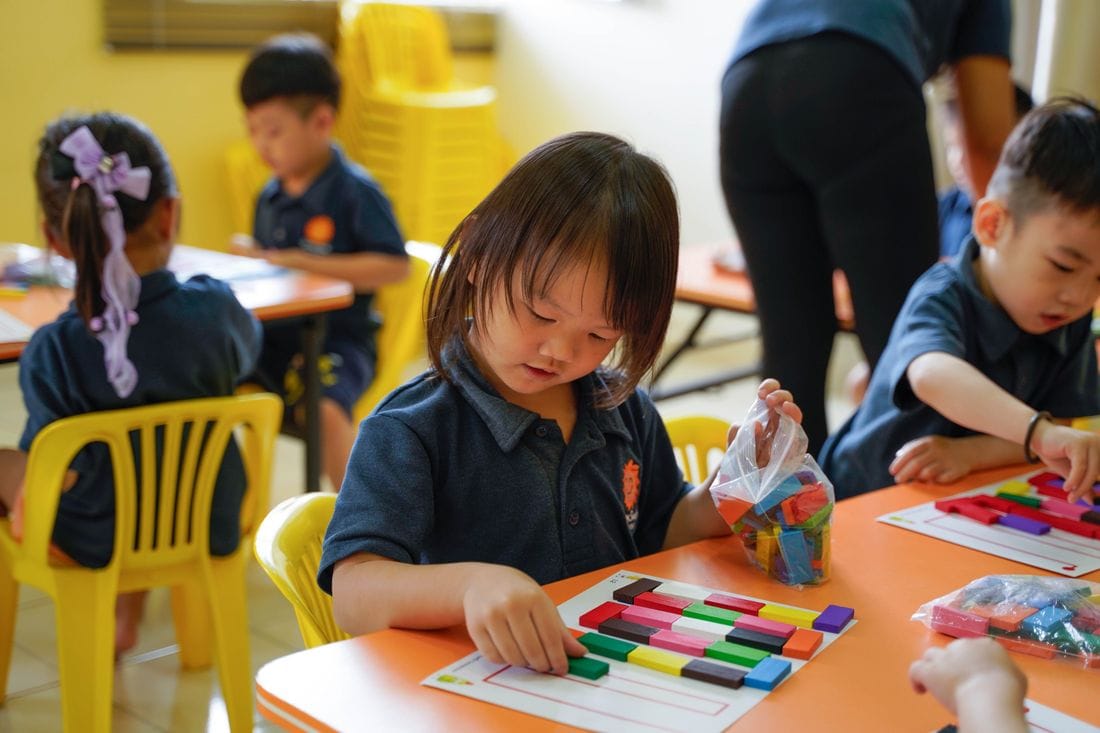
Numeracy is part of our nursery programme, and children in preschool and kindergarten learn mathematics through Eureka Maths, with hands on tools and logical thinking. See how maths sits alongside the three languages on our curriculum page. For more home ideas, our guide to fine motor play has six supervised activities, and getting ready for Primary 1 covers the everyday skills to talk about before Year 1.
Printable
Number and amount matching cards
Match each numeral from 1 to 10 with a dot card showing that amount. Count each dot once together. Point on screen or paper; cutting is optional and only for an adult. No score.
SunnySeeds Academy · sunnyseeds.com.my
1
2
3
4
5
6
7
8
9
10
● ● ●
● ● ● ● ●
● ●
●
● ● ● ● ●
● ● ● ●
● ● ● ● ●
● ●
● ● ● ● ●
● ● ● ● ●
● ● ● ● ●
●
● ● ● ●
● ● ● ● ●
● ● ●
Home matching cards written by SunnySeeds Academy, 4 November 2026. Not a test and not scored. If you cut the cards out, an adult keeps them and puts them away after play.
Sources
Sources checked 4 November 2026. Official pages can change, so check the source before acting on a date or rule.
Related guides
- Fine motor play at home: six supervised activities with everyday materialsSix supervised hand and finger activities with large, safe household materials, with steps, adaptations, cleanup and a printable planner.
- Getting ready for Primary 1: the everyday skills to talk about at homeCommunication, routines, independence and asking for help, with a printable conversation checklist for home and the teacher meeting.
- All parent guidesSeventeen guides for parents of children aged 2 to 6.
FAQ
Questions parents ask
Why can my child recite numbers but not count a group of toys?
Reciting number names and counting a group involve different skills. Counting together slowly, touching each object once and then asking how many, gives practice linking the number words to the amount. Ask your child's teacher about the skills they practise in class.
Should my child learn to write numbers first?
There is no single required order. Counting real things and talking about amounts can go alongside noticing written numerals around the home, such as on lift buttons or a clock. Writing numerals is a separate skill. Your child's teacher can tell you what they practise in class.
Do I need to cut out the matching cards?
No. You can print the sheet, or use it on screen, and point to a numeral and then to the amount card with the same number of dots. If you do cut the cards out, an adult does the cutting and the cards are put away after play.
Book a school visit
Come during morning school hours to see what we do, and bring your child along.